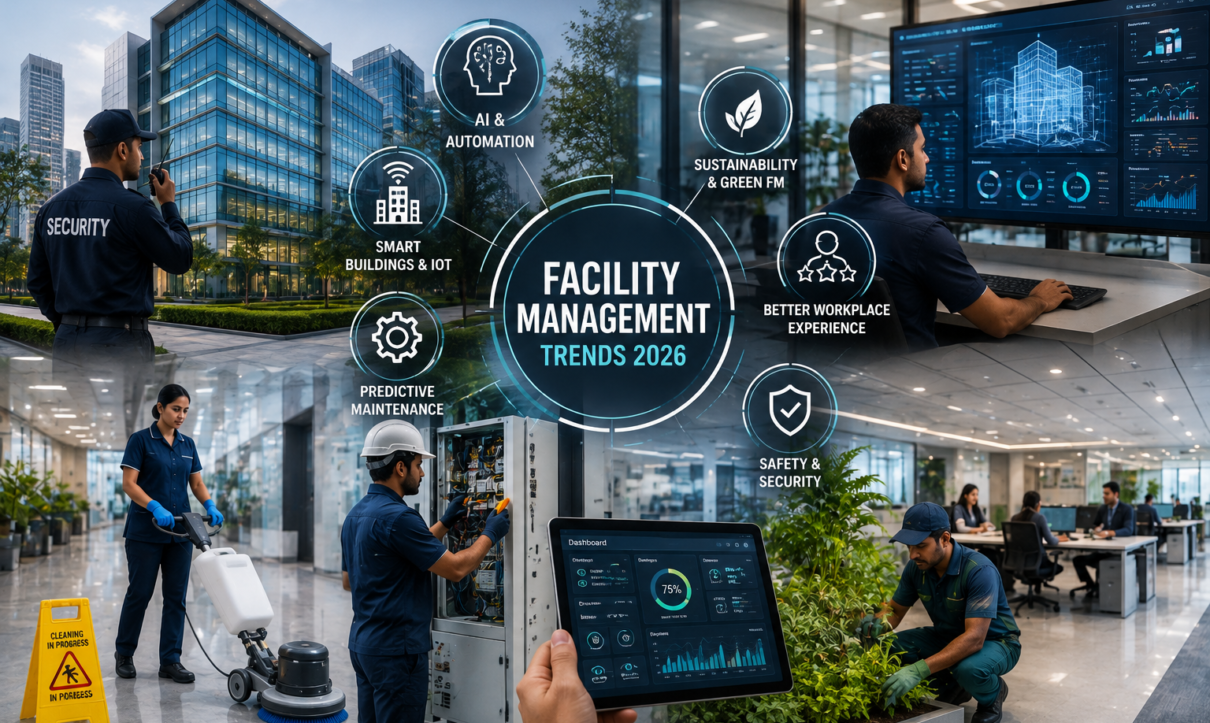
Facility management is rapidly evolving from traditional housekeeping and maintenance into a technology-driven, data-focused business function. In 2026, businesses are increasingly looking for smarter ways to improve workplace efficiency, reduce operating costs, strengthen security, and create better employee experiences.
For businesses across Noida, Ghaziabad, Greater Noida, Noida Extension, Faridabad, Gurgaon, Meerut, Rajasthan, and West UP, understanding these trends can help them build safer, more efficient, and future-ready facilities.
1. AI-Powered Facility Management
Artificial Intelligence is becoming an important part of modern facility operations. AI can analyze building and equipment data, automate routine workflows, identify operational issues, and support predictive maintenance.
In 2026, facility teams are increasingly moving from reactive problem-solving toward data-driven and predictive operations.
2. Smart Buildings & IoT
Internet of Things (IoT) technology allows sensors and connected devices to provide real-time information about occupancy, temperature, energy consumption, equipment performance, and building conditions.
Integrated building systems can help facility managers identify inefficiencies and make faster operational decisions.
3. Predictive & Preventive Maintenance
Instead of waiting for equipment to break down, businesses are increasingly focusing on predictive and preventive maintenance. AI and connected sensors can help identify potential equipment problems earlier, reducing unexpected downtime and improving asset performance.
This is particularly valuable for offices, industrial facilities, hospitals, warehouses, and commercial properties.
4. Energy Efficiency & Sustainability
Energy performance has become a major priority for facility managers. Businesses are focusing on energy monitoring, efficient HVAC systems, smart lighting, water management, waste reduction, and sustainable operations.
Current 2026 FM research shows that energy efficiency and sustainability are among the leading priorities for technology investment.
5. Better Workplace Experience
Facility management is increasingly focused on people, not just buildings. Comfortable workplaces, clean surroundings, green spaces, indoor environmental quality, flexible spaces, and employee-friendly facilities can contribute to a better workplace experience.
India’s 2026 office occupier research also highlights workplace experience, sustainability, and flexible workspace strategies as important considerations for businesses.
6. Integrated Facility Management
Businesses are increasingly choosing integrated facility management solutions instead of managing individual services separately. Security, housekeeping, pest control, horticulture, maintenance, pantry services, and manpower support can be coordinated through a single professional partner.
This approach can simplify vendor management, improve accountability, and create more consistent service standards.
7. Data-Driven Decision Making
Modern facility managers are using operational data to understand space utilization, equipment performance, energy consumption, maintenance requirements, and service quality.
The FM industry is moving toward connected systems where reliable data can support better budgeting, staffing, maintenance planning, and risk management.
8. Stronger Focus on Security & Cybersecurity
As physical facilities become more connected, security requirements are also changing. Businesses need stronger access control, surveillance, emergency preparedness, and protection for connected building systems.
Cybersecurity is becoming an important consideration alongside traditional physical security as smart building technologies expand.
9. Skilled & Technology-Ready FM Professionals
Technology does not replace the importance of trained facility personnel. Instead, modern FM requires professionals who can combine practical operational knowledge with digital tools, data, safety procedures, and customer-service skills.
Training and workforce development will remain important as facility operations become more complex.
Why These Trends Matter for Businesses
For organizations in Noida, Ghaziabad, Greater Noida, Noida Extension, Faridabad, Gurgaon, Meerut, Rajasthan, and West UP, adopting modern facility management practices can help improve operational efficiency, workplace safety, asset performance, sustainability, and employee experience.
At ProMax Solutions, we understand the changing requirements of modern businesses and provide integrated facility management solutions covering security, housekeeping, pest control, horticulture, maintenance, home care, pantry staff, helper services, special event management, and security consultancy.
Conclusion
Facility management in 2026 is becoming smarter, more connected, sustainable, and people-focused. AI, IoT, predictive maintenance, energy optimization, integrated services, and data-driven decision-making are shaping the future of facility operations.
Businesses that adopt the right combination of technology, trained manpower, and professional facility management can create safer, cleaner, more efficient, and future-ready workplaces.
For businesses across Noida, Ghaziabad, Greater Noida, Noida Extension, Faridabad, Gurgaon, Meerut, Rajasthan, and West UP, professional integrated facility management can be an important step toward long-term operational efficiency and business growth.